

A Complete Resume Handbook by The Scoop Labs
01. Introduction: The Importance of Your First Resume
Whether you’re stepping out of college, applying for your first internship, or starting your professional journey, your resume is far more than a document; it’s your story of potential. It represents who you are, what you’ve accomplished, and how you can contribute to an organisation.
For students and fresh graduates, building a resume can feel challenging. You may often wonder, “What do I include if I don’t have real work experience?”
Here’s the truth: you already have more to show than you think. Academic projects, internships, technical training, volunteering, and even college club activities all showcase your learning, initiative, and capability.
At The Scoop Labs, we believe every student can transform their academic journey into a professional narrative that attracts attention, not just from recruiters, but also from the ATS (Applicant Tracking Systems) that screen most resumes before they reach a human.
This guide walks you through every section, step by step, helping you craft a resume that’s clear, credible, and impactful.
02. Watch the Complete Resume Guide (Video Walkthrough)
Prefer watching instead of reading? We’ve explained this entire resume-building process step-by-step in the video below.
Placement Clients


MSME Companies in UK & US
03. Structuring Your Resume the Professional Way
A strong resume isn’t about flashy designs or multiple colours; it’s about clarity, relevance, and readability. A well-structured layout ensures both recruiters and ATS software can scan your details easily.
Your resume should follow a clean, single-column format, ideally divided into these sections:
- Header Section
- Profile Summary
- Internship Section
- Projects / Training Section
- Technical Skills
- Education
- Certifications / Achievements
- Optional Sections (Languages, Volunteering, References)
Each section serves a purpose. Together, they tell your complete professional story in a format that’s recruiter-friendly and ATS-approved.
04. Header Section: Your First Impression
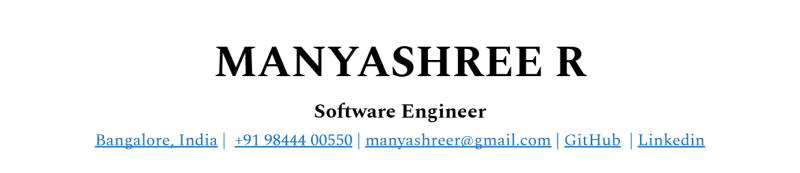
Your Header is the top section of your resume, the first place a hiring manager looks. It should clearly show your contact details and professional identity.
- Full Name (bold and slightly larger font)
- Professional Title or Role(e.g., “Full Stack Developer”).
- Professional Email ID — Use a formal format: [email protected] or [email protected].
- LinkedIn Profile URL
- GitHub or Portfolio Link (optional)
- Phone Number with country code.
- Location: Include only your city & country. Avoid full addresses for privacy.
- Profile Picture: Generally not required unless applying in creative industries or European regions
Example:
05. Profile Summary: Your Quick Value statement
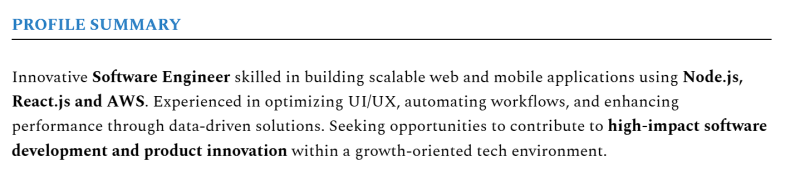
Think of your Profile Summary as your personal introduction, a short, powerful statement that gives recruiters a snapshot of who you are.
It should answer three key questions:
- Who are you professionally?
- What are your main strengths or areas of expertise?
- What kind of role or opportunity are you seeking?
Example:
Tips for an Impactful Summary:
- Keep it 3–4 concise lines.
- Avoid generic buzzwords like “hard-working” or “team player.”
- Use strong, skill-based language (“Proficient in…”, “Experienced with…”).
- Tailor it to the specific role you’re targeting.
A recruiter should instantly understand your strengths and potential from this short paragraph
Recent Job Descriptions

06. Internships / Experience: Your Initial Professional Journey
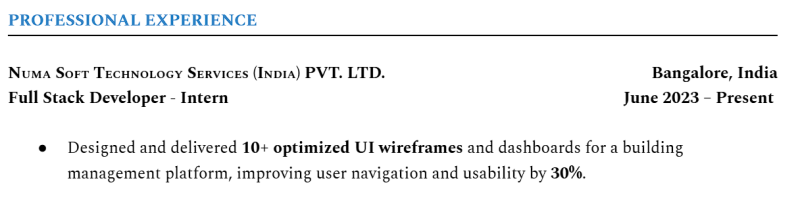
If you don’t yet have full-time experience, highlight internships or certified training programs. These show initiative and a willingness to learn.
Example:
Tips for an Impactful Internship section:
- Even short internships matter; focus on skills learned and applied.
- Mention tools, technologies, and methodologies you used.
- If you completed The Scoop Labs Resume Builder or Training Program, include it proudly as part of your professional development.
Internships and training programs communicate readiness, adaptability, and eagerness to grow, key traits that employers look for.
07. Projects: Your Real-World Skill Proof
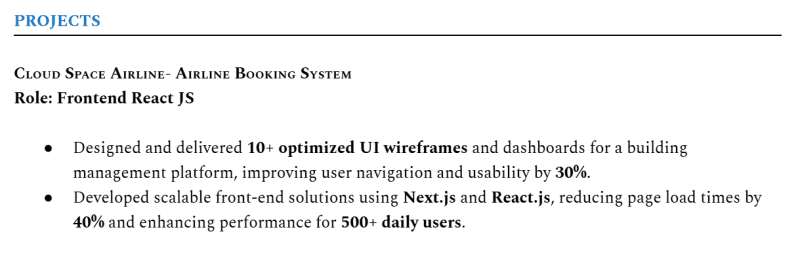
Projects showcase how you’ve applied your skills to solve problems or create real results. They’re especially valuable for students in tech, engineering, or creative fields.
What to Include:
- Project Title
- Duration or Academic Context
- Technologies Used
- Key Outcomes or Results
Example:
Tips for an Impactful Projects section:
- Include 2–4 impactful projects.
- Focus on outcomes and measurable success.
- Use consistent formatting for all entries
- Highlight teamwork or leadership if applicable.
Projects illustrate your ability to execute ideas, not just learn theory.
08. Technical Skills: Your Key Capability Overview
Your Skills Section gives recruiters a quick technical overview of your capabilities. Grouping skills by category improves readability and helps with ATS keyword scanning.
Example:
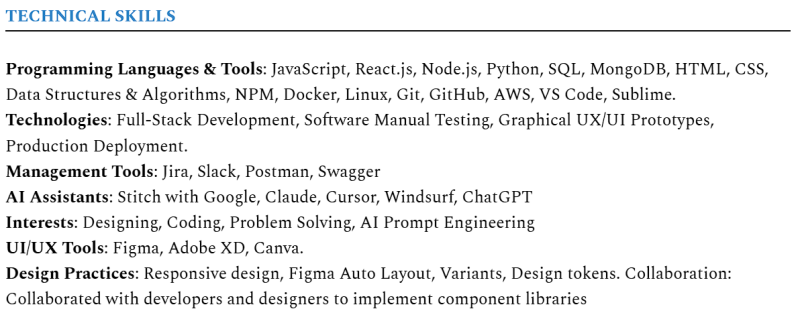
Tips for an Impactful Skills section:
- Focus on relevant skills aligned to the job description.
- Avoid cluttering with outdated or rarely used tools.
- Ensure your skill keywords appear throughout your resume; this boosts ATS match rates.
At Scoop Labs, we help students identify their core strengths and structure them for maximum professional visibility.
09. Education: Building Your Academic Foundation
List your educational qualifications in reverse chronological order, your most recent degree first.
Example:
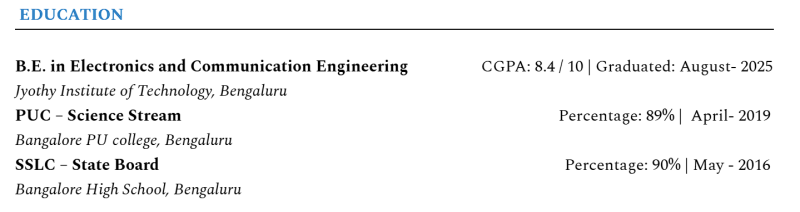
Tips for an Impactful Education section:
- Mention degree, institution, and year of completion.
- Include academic distinctions or key coursework (e.g., Data Structures, Cloud Computing, AI).
- This section reflects both your discipline and educational credibility.
10. Certifications & Achievements: Proof of Growth
This section demonstrates your initiative in learning beyond the classroom. Employers value certifications that show motivation and curiosity.
Example:
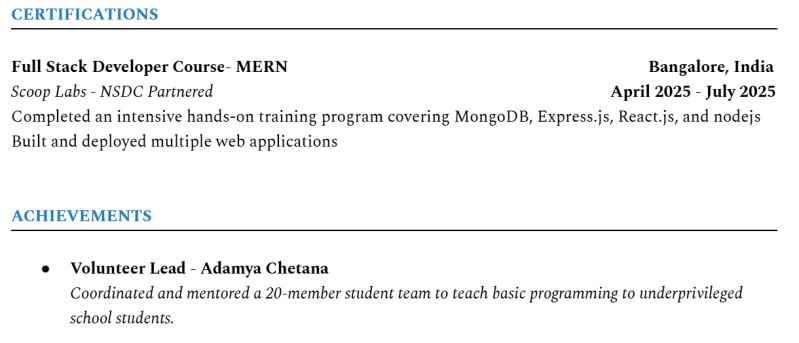
Tips for an Impactful Certifications & Achievements section:
- Keep it relevant; include only certifications that strengthen your target role.
- Avoid overstuffing; list 3–5 impactful achievements.
- Prioritise recent and verifiable credentials.
11. Optional Sections: Adding Personal Depth
Optional sections help give a human touch to your resume. They show personality, interests, and the ability to contribute beyond academics. Recruiters often check these to understand cultural fit.
Common Optional Sections:
- Languages: English (Fluent), Hindi (Fluent), Kannada (Native)
- Extracurricular Activities: Core Committee Member, Coding Club, organised hackathons with 150+ participants.
- Volunteer Work: Taught basic programming at a local NGO under a student mentorship program
- Interests/Hobbies: Avoid generic hobbies like “listening to music
Keep this section short; it’s optional for a reason
12. Building for the ATS: Your Resume’s First Audience
Most freshers don’t realise that their resume is usually read by software before a human. ATS filters resumes based on structure, keywords, and formatting. If your resume isn’t ATS-friendly, it gets rejected instantly.
What Is an ATS and Why Does It Matter?
An Applicant Tracking System scans and ranks resumes based on structure and keywords. If your resume isn’t formatted correctly or lacks the right phrases, it may never reach a recruiter.
Over 98% of Fortune 500 companies use ATS to screen applicants. So, for students, ATS readiness significantly boosts visibility.
Tips for ATS-Friendly Formatting
- Use standard headings (“Experience”, “Skills”, “Education”, etc.)..
- Avoid tables, text boxes, and graphics.
- Stick to plain fonts like Calibri, Arial, or Times New Roman (size 10–12).
- Save in .docx or PDF format, as specified in the job post
- Naturally integrate keywords from the job description, without overstuffing.
13. Resume Audit Tools: Check Your Resume Like a Recruiter
Before sending your resume out, use online tools to audit and improve it. These tools simulate ATS and recruiter scanning so you understand your strengths and gaps.
Recommended Tools:
- Resumeworded.com: Analyses structure, readability, and keyword balance.
- SkillSyncer.com: Compares your resume to a job description and identifies missing skills.
- Jobscan.co: Provides a “match rate” score and suggests improvements.
Try for a match score of 80–90% or higher against your target job. Different tools score differently; use them as guides, not strict measures.
14. Customise Your Resume for Every Job Description: Align with Each Role
The biggest mistake freshers make is sending the same resume everywhere. Every company and job role has different expectations, and your resume should reflect that. Even a 10% personalisation increases interview chances drastically.
Why "One-Size-Fits-All" Doesn’t Work?
- Each Job Description (JD) emphasises different skills.
- ATS scanners prioritise JD-specific keywords.
- Human recruiters recognise when resumes are generic
What to Customise?
- Objective/Summary: Tailor this for each job.
- Skills: Highlight only the top skills relevant to that job
- Projects/Experience: Align bullet points with keywords in the JD.
- Keywords: Use the same phrasing recruiters use, naturally and accurately.
Customisation signals genuine interest and boosts both ATS ranking and recruiter approval.
15. Common Mistakes Freshers Should Avoid
Freshers lose opportunities because of avoidable mistakes. Many resumes get rejected not for lack of talent but for poor presentation.
- Typos and grammatical mistakes: proofread carefully
- Generic buzzwords: use results-driven language.
- Over-designed layouts: keep it simple and professional.
- Sending the same resume everywhere: always tailor your version.
Remember: Clarity beats creativity for early-career resumes.
16. The Scoop Labs Advantage
At Scoop Labs, we specialise in helping students build resumes that look professional and perform effectively
Our Resume Builder Program offers
- 1:1 Mentorship: Personalized guidance on presenting academic and project experience.
- Resume Audits: Format, ATS, and keyword optimisation
- Professional Templates: Recruiter-approved and easy to customise.
- Mock Interviews: Learn how to discuss your resume confidently
We don’t just help you write a resume; we teach you how to present yourself strategically in a competitive job market.
17. Conclusion: Your Resume Is the First Step
Your resume isn’t a formality; it’s your first handshake with your professional future. It reflects your learning, growth, and readiness to take on real-world challenges.
You don’t need years of experience to make a strong impression; you just need clarity, authenticity, and structure.
At Scoop Labs, we help students craft resumes that get noticed, interviews that convert, and careers that take off.
Your first job could be just one page away. Let’s make that page unforgettable.
18.
Navigate to Address
Scoop Labs
59, 2nd Floor, VLM Towers, 10th Cross Road, 2nd Stage, Padmanabha Nagar, Banashankari, Bengaluru, Karnataka 560070
Get Direction: Banashankari
Submit a Request
Recent Posts


