
Overview
Selecting the right Amazon Elastic Compute Cloud (Amazon EC2) instance is one of the most important decisions when deploying workloads on Amazon Web Services (AWS). The instance type you choose directly affects application performance, scalability, availability, and cloud infrastructure costs. While selecting an instance with insufficient resources can lead to performance bottlenecks, choosing an oversized instance often results in unnecessary expenses that increase operational costs without providing meaningful benefits.
Amazon EC2 offers hundreds of instance types optimized for different workloads, ranging from lightweight web applications to machine learning, big data analytics, enterprise databases, and high-performance computing. Understanding how to evaluate CPU, memory, storage, networking, and pricing models enables organizations to build efficient cloud environments while controlling costs.
As cloud adoption continues to grow across industries, understanding EC2 instance selection has become an essential skill for cloud engineers, DevOps professionals, software developers, system administrators, and solution architects. For professionals focused on Upskilling and improving Job Readiness, learning how to choose the right EC2 instance develops practical cloud architecture knowledge that is highly valued in modern IT environments.
What Is an Amazon EC2 Instance?
An Amazon EC2 instance is a virtual server that runs applications in the AWS Cloud.
Each instance provides configurable computing resources including:
- Virtual CPUs (vCPUs)
- Memory (RAM)
- Storage
- Networking
- Operating System
- Security Configuration
Organizations use EC2 instances to host:
- Web applications
- REST APIs
- Databases
- Enterprise applications
- Development environments
- Machine Learning workloads
- Container platforms
Because different applications have different resource requirements, AWS offers multiple EC2 instance families optimized for specific workloads.
Why Is Choosing the Right EC2 Instance Important?
Selecting an appropriate EC2 instance affects both application performance and operational costs.
A well-sized instance helps organizations:
- Improve application responsiveness
- Reduce cloud infrastructure expenses
- Optimize resource utilization
- Support application scalability
- Increase system reliability
- Maintain cost efficiency
Overprovisioning resources often leads to higher monthly cloud bills, while underprovisioning may cause slow applications, system crashes, or degraded user experiences.
How Are EC2 Instance Families Organized?
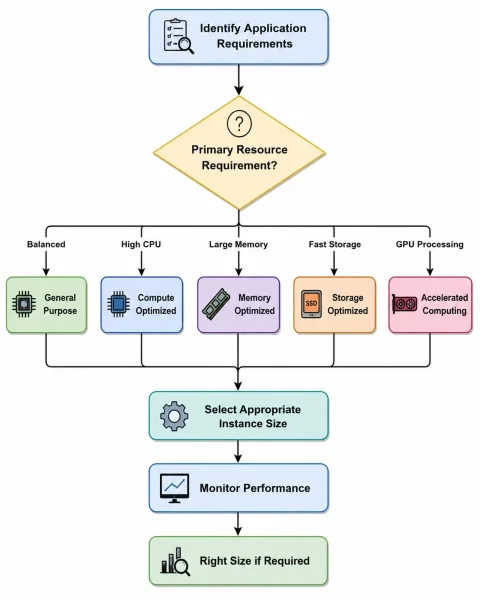
AWS groups EC2 instances into families based on workload characteristics.
Each family is optimized for specific computing requirements.
General Purpose Instances
General Purpose instances balance CPU, memory, and networking resources.
Best suited for:
- Business applications
- Development environments
- Web servers
- Small databases
- Enterprise applications
Examples include:
- T3
- T4g
- M7i
- M6i
Compute Optimized Instances
These instances provide higher CPU performance for compute-intensive workloads.
Suitable for:
- Batch processing
- High-performance web servers
- Gaming servers
- Scientific computing
- CI/CD pipelines
Examples include:
- C7g
- C7i
- C6i
Memory Optimized Instances
Applications requiring large amounts of RAM benefit from Memory Optimized instances.
Common use cases include:
- SAP workloads
- Large databases
- Real-time analytics
- In-memory caching
- Big data processing
Examples include:
- R7i
- X2idn
- High Memory instances
Storage Optimized Instances
Designed for applications requiring high-speed local storage.
Typical workloads include:
- NoSQL databases
- Data warehousing
- Elasticsearch
- Log processing
- Analytics platforms
Examples include:
- I4i
- Im4gn
- D3
Accelerated Computing Instances
These instances include specialized hardware such as GPUs.
Used for:
- Artificial Intelligence
- Machine Learning
- Video rendering
- Scientific simulations
- Deep learning
Examples include:
- G5
- P5
- Trn1
Placement Clients


MSME Companies in UK & US
How Can You Identify the Right Instance for Your Workload?
Choosing an EC2 instance begins with understanding application requirements.
Consider the following factors:
CPU Requirements
Applications performing intensive calculations require higher vCPU capacity.
Examples include:
- Data processing
- Build servers
- Video encoding
- Simulation software
Memory Requirements
Applications storing large datasets in memory require additional RAM.
Examples include:
- Database servers
- Redis
- SAP applications
- Analytics engines
Storage Requirements
Determine whether the application needs:
- Temporary storage
- Persistent storage
- High-speed SSD storage
- Large-capacity HDD storage
Storage selection directly affects both performance and cost.
Network Performance
Applications serving thousands of concurrent users may require enhanced networking capabilities.
Examples include:
- Streaming platforms
- Enterprise APIs
- Multiplayer gaming
- Large-scale web applications
How Do AWS Pricing Models Help Reduce Costs?
AWS offers multiple purchasing options that allow organizations to optimize cloud spending.
On-Demand Instances
Ideal for:
- Development
- Testing
- Short-term projects
- Unpredictable workloads
No long-term commitment is required.
Reserved Instances
Designed for workloads with predictable resource requirements.
Benefits include:
- Lower hourly pricing
- Long-term savings
- Capacity reservation
Suitable for production applications running continuously.
Spot Instances
AWS provides unused compute capacity at discounted prices.
Best suited for:
- Batch processing
- Testing
- Data analysis
- Fault-tolerant applications
Although significantly cheaper, Spot Instances may be interrupted when AWS requires capacity.
Savings Plans
Savings Plans provide flexible pricing while allowing organizations to use multiple EC2 instance families.
They combine cost savings with greater deployment flexibility.
EC2 Instance Selection Workflow
Recent Job Descriptions

 What Are Common Mistakes That Increase AWS Costs?
Many organizations overspend because they choose larger instances than necessary.
Some common mistakes include:
Selecting Oversized Instances
Provisioning more CPU and memory than required increases monthly expenses without improving application performance.
Ignoring Performance Monitoring
Applications evolve over time.
Regular monitoring helps identify opportunities for rightsizing.
Running Development Servers Continuously
Non-production environments often remain active outside business hours, resulting in unnecessary compute charges.
Choosing Expensive Storage Unnecessarily
Premium storage options should only be used when applications genuinely require high performance.
Not Reviewing Pricing Options
Organizations frequently continue using On-Demand pricing even when Reserved Instances or Savings Plans would significantly reduce costs.
What Best Practices Help Optimize EC2 Costs?
To maximize performance while controlling expenses:
- Analyze workload characteristics before selecting an instance.
- Start with smaller instances and scale as needed.
- Continuously monitor CPU, memory, and network utilization.
- Implement Auto Scaling for variable workloads.
- Use Reserved Instances for predictable production environments.
- Consider Spot Instances for fault-tolerant workloads.
- Regularly review cloud spending and rightsize resources.
These practices help maintain both performance and cost efficiency.
Why Is EC2 Instance Selection Important for Cloud Professionals?
Cloud architects and DevOps engineers are expected to design infrastructure that balances performance, scalability, reliability, and operational costs.
Organizations involved in Technical Hiring increasingly assess candidates on real-world cloud architecture decisions rather than simply testing AWS terminology. Understanding EC2 instance families, pricing models, and workload optimization demonstrates practical cloud expertise during Interview Preparation.
Developing hands-on experience with AWS infrastructure also supports long-term Career Guidance, enabling professionals to build efficient and cost-effective cloud solutions for modern enterprises.
Conclusion
Selecting the right Amazon EC2 instance is about more than choosing a virtual server—it requires understanding workload characteristics, performance requirements, storage needs, networking demands, and pricing models. By evaluating application requirements carefully and applying rightsizing strategies, organizations can avoid unnecessary cloud expenses while maintaining reliable and scalable infrastructure. Mastering EC2 instance selection equips cloud professionals with practical knowledge that supports better architectural decisions and efficient resource management.
For learners seeking practical AWS experience, Placement Support, Placement Assistance, Resume Building, and project-based cloud training in Banashankari, Bangalore, Scoop Labs offers industry-oriented learning designed to help students and professionals build real-world expertise in AWS Cloud and modern infrastructure technologies.
Submit a Request
Recent Posts


