

01. Overview
Every financial transaction recorded in an SAP ERP system begins with a fundamental organizational unit known as the Company Code. Whether an organization is processing customer invoices, posting vendor payments, generating financial statements, or closing its books at the end of a fiscal year, every accounting entry is ultimately linked to a company code.
For organizations implementing SAP FICO, defining company codes correctly is one of the first and most critical configuration activities. They serve as the legal accounting entities responsible for maintaining financial records, preparing statutory reports, and ensuring compliance with regional accounting regulations.
As SAP continues to be one of the most widely adopted ERP platforms across manufacturing, retail, healthcare, banking, logistics, and service industries, understanding company codes has become an essential skill for aspiring SAP consultants, finance professionals, and ERP administrators. Professionals focusing on Upskilling and Job Readiness often begin their SAP journey with organizational structure concepts because they form the foundation for every financial process within SAP FICO.
02. What Is a Company Code in SAP FICO?
A Company Code is the smallest organizational unit in SAP Financial Accounting (FI) for which complete financial statements can be generated.
Every company code represents a legally independent accounting entity capable of producing its own:
- Balance Sheet
- Profit and Loss Statement
- Trial Balance
- Cash Flow Reports
- Tax Reports
- Financial Statements
Each accounting transaction posted within SAP belongs to exactly one company code, ensuring financial records remain organized and compliant with statutory requirements.
Placement Clients


MSME Companies in UK & US
03. Why Is the Company Code Considered the Foundation of SAP Financial Accounting?
The company code acts as the central accounting entity throughout SAP.
Almost every financial transaction references it directly or indirectly.
It enables organizations to:
- Record accounting transactions accurately
- Maintain separate books for different legal entities
- Generate country-specific financial reports
- Comply with taxation and regulatory requirements
- Consolidate financial data across multiple business units
Without a properly configured company code, organizations cannot perform core accounting activities within SAP FI.
04. How Is a Company Code Created in SAP?
During SAP implementation, consultants configure company codes based on organizational requirements.
Typical configuration includes:
- Company Code ID
- Company Name
- CountryCurrency
- Language
- Fiscal Year Variant
- Chart of Accounts Assignment
- Local Address
- Tax Configuration
These settings determine how financial transactions are processed throughout the system.
05. SAP Company Code Configuration Workflow

Recent Job Descriptions

06. What Is the Difference Between a Company and a Company Code?
Many beginners confuse these two concepts.
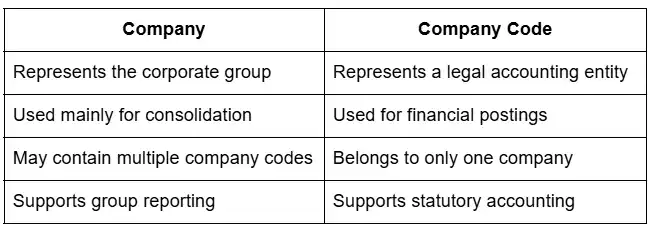
Understanding this distinction is fundamental when learning SAP organizational structures.
07. How Does the Company Code Interact with Other SAP Modules?
The company code integrates with several SAP modules.
SAP MM (Materials Management)
- Vendor invoices
- Goods receipt accounting
- Inventory valuation
SAP SD (Sales and Distribution)
- Customer billing
- Revenue recognition
- Receivable postings
SAP CO (Controlling)
- Cost centers
- Internal orders
- Profit centers
SAP Asset Accounting
- Asset acquisition
- Depreciation
- Asset retirement
This integration enables seamless financial reporting across the organization.
08. Can One Organization Have Multiple Company Codes?
Yes.
Large organizations frequently operate across multiple countries or maintain separate legal entities.
Each legal entity generally has its own company code.
For example:
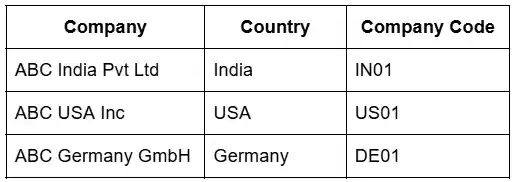
This structure allows each entity to maintain independent financial records while supporting consolidated reporting.
09. What Are Common Mistakes Made While Configuring Company Codes?
Incorrect company code configuration can affect multiple downstream financial processes.
Some common mistakes include:
- Assigning the wrong fiscal year variant
- Incorrect local currency selection
- Improper chart of accounts assignment
- Missing tax configuration
- Inconsistent country-specific settings
Careful planning during SAP implementation helps avoid these issues.
10. Why Is Understanding Company Codes Important for SAP Professionals?
Company codes form the basis of nearly every financial process in SAP.
Whether working as:
- SAP FICO Consultant
- ERP Functional Consultant
- Financial Analyst
- SAP Support Engineer
- Business Process Consultant
professionals regularly work with company code configurations and financial postings.
Organizations involved in Technical Hiring often expect candidates to understand core SAP organizational structures before progressing to advanced financial accounting topics.
For learners pursuing Career Guidance, structured SAP learning combined with hands-on practice significantly improves practical understanding. Working on real implementation scenarios also strengthens Interview Preparation by helping candidates explain SAP concepts beyond theory.
11. What Career Opportunities Exist After Learning SAP FICO?
SAP FICO continues to be one of the most sought-after ERP specializations.
Professionals with strong SAP knowledge can pursue roles such as:
- SAP FICO Consultant
- ERP Financial Consultant
- SAP Functional Analyst
- Finance Transformation Consultant
- SAP Support Specialist
Developing expertise in organizational structures, General Ledger, Accounts Payable, Accounts Receivable, Asset Accounting, and Controlling contributes to long-term Career Growth while improving overall Job Readiness for ERP implementation projects.
12. Conclusion
Company codes serve as the backbone of financial accounting in SAP FICO. They establish the legal framework within which organizations record transactions, prepare statutory reports, and maintain financial compliance. Understanding their purpose, configuration, and integration with other SAP modules provides a strong foundation for anyone beginning a career in SAP or enterprise resource planning.
For learners looking to build practical SAP expertise through industry-oriented projects, Placement Support, Placement Assistance, and hands-on ERP training in Banashankari, Bangalore, Scoop Labs offers structured learning pathways that help bridge the gap between theoretical concepts and real-world SAP implementation requirements.
Navigate to Address
Scoop Labs
59, 2nd Floor, VLM Towers, 10th Cross Road, 2nd Stage, Padmanabha Nagar, Banashankari, Bengaluru, Karnataka 560070
Get Direction: Banashankari
Submit a Request
Recent Posts


