

01. Overview
Artificial Intelligence has transformed the way individuals and organizations solve problems, analyze information, and automate decision-making. From generating code and summarizing documents to answering technical questions and assisting with business operations, Large Language Models (LLMs) have become valuable tools across industries. However, the quality of an AI-generated response often depends not only on the model itself but also on how the question is asked. This is where Chain-of-Thought (CoT) Prompting plays a significant role.
Chain-of-Thought Prompting is a prompting technique that encourages AI models to reason through a problem by breaking it into smaller logical steps before producing a final answer. Instead of generating an immediate response, the model follows a structured reasoning process, allowing it to handle complex tasks with greater accuracy and consistency. This approach has become increasingly important for applications involving mathematics, programming, logical reasoning, data analysis, and technical problem-solving.
As organizations continue integrating AI into software development, cloud computing, cybersecurity, business intelligence, and enterprise automation, understanding advanced prompting techniques has become an essential skill. For professionals focused on Upskilling and improving Job Readiness, learning how to interact effectively with AI systems provides practical knowledge that enhances productivity across modern technology environments.
02. What Is Chain-of-Thought Prompting?
Chain-of-Thought Prompting is a prompt engineering technique that encourages an AI model to process information through intermediate reasoning steps before generating a final response.
Rather than producing an immediate answer, the model is guided to examine the problem systematically by identifying relevant information, evaluating possible solutions, and arriving at a logical conclusion.
This structured reasoning approach is especially useful for tasks involving:
- Logical reasoning
- Mathematical calculations
- Programming problems
- Multi-step decision-making
- Technical troubleshooting
- Data interpretation
By breaking complex problems into manageable steps, AI models often generate responses that are more accurate and contextually appropriate.
Placement Clients


MSME Companies in UK & US
03. Why Does Chain-of-Thought Prompting Improve AI Responses?
Large Language Models generate responses by predicting the most probable sequence of words based on patterns learned during training.
For simple questions, this prediction process usually works well.
However, complex problems often require multiple reasoning stages before reaching the correct conclusion.
Chain-of-Thought Prompting encourages the model to:
- Analyze the problem carefully.
- Identify relevant information.
- Consider logical relationships.
- Reduce reasoning mistakes.
- Produce more structured explanations.
This approach improves response quality for tasks that involve multiple interconnected concepts.
04. How Does Chain-of-Thought Prompting Work?
Instead of asking the model for a direct answer, prompts encourage it to evaluate the problem step by step.
A simplified reasoning workflow looks like this:
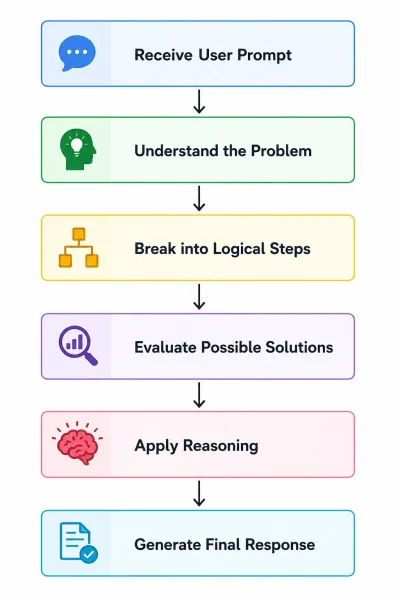 Each stage builds upon the previous one, helping the model organize information before producing the final output.
05. Where Is Chain-of-Thought Prompting Most Useful?
Certain types of problems benefit significantly from structured reasoning.
Software Development
Developers use Chain-of-Thought Prompting to:
- Debug application errors
- Analyze algorithms
- Explain code logic
- Design software architecture
- Optimize application performance
Breaking coding problems into logical stages often produces more reliable solutions.
Cloud Computing
Cloud professionals can use this technique for:
- Infrastructure planning
- Resource optimization
- Cost estimation
- Deployment troubleshooting
- Architecture design
Structured reasoning helps evaluate multiple cloud services before selecting the most appropriate solution.
Data Analysis
When interpreting datasets, AI can reason through:
- Data cleaning
- Trend identification
- Statistical interpretation
- Business insights
- Performance evaluation
This improves the consistency of analytical outputs.
Cybersecurity
Security professionals often investigate incidents involving multiple systems and potential attack paths.
Chain-of-Thought Prompting helps AI organize:
- Security observations
- Risk analysis
- Threat investigation
- Vulnerability assessment
- Incident response recommendations
Recent Job Descriptions

06. How Is Chain-of-Thought Prompting Different from Traditional Prompting?
Traditional Prompting Chain-of-Thought Prompting Direct answer generation Step-by-step reasoning Best for simple questions Best for complex problems Limited intermediate analysis Structured logical evaluation Higher chance of reasoning errors Improved logical consistency Shorter responses More comprehensive explanations
Although both approaches have value, Chain-of-Thought Prompting is generally more effective for problems requiring multiple reasoning stages.
07. What Are the Advantages of Chain-of-Thought Prompting?
Using structured reasoning offers several benefits.
Improved Problem Solving
Complex problems become easier to analyze when divided into smaller logical components.
Better Accuracy
Reasoning through intermediate steps reduces the likelihood of incorrect conclusions.
Greater Transparency
Well-structured explanations help users understand how conclusions are reached.
Enhanced Decision Support
Business, technical, and engineering decisions often require evaluating multiple factors before selecting the best option.
Chain-of-Thought Prompting supports this structured evaluation process.
More Reliable Technical Assistance
For troubleshooting software, cloud infrastructure, or networking issues, systematic reasoning frequently produces more practical recommendations.
08. What Are the Limitations of Chain-of-Thought Prompting?
Although highly effective, this technique has certain limitations.
Some common challenges include:
Increased Response Length
Reasoning through multiple steps naturally produces longer outputs.
Additional Processing Time
More detailed reasoning may require additional computational resources.
Dependence on Prompt Quality
Poorly written prompts can still produce incomplete or inaccurate reasoning.
Not Necessary for Simple Questions
Straightforward factual questions generally do not require multi-step reasoning.
Selecting the appropriate prompting strategy depends on the complexity of the task.
09. What Are Best Practices for Writing Effective Chain-of-Thought Prompts?
To obtain better AI responses:
- Clearly define the objective.
- Provide sufficient background information.
- Break complex tasks into manageable parts.
- Specify expected outputs.
- Ask the model to evaluate alternatives where appropriate.
- Include relevant constraints and assumptions.
- Review AI-generated results before implementation.
Well-designed prompts significantly improve response quality across technical and business use cases.
10. Why Is Understanding Chain-of-Thought Prompting Important for AI Professionals?
As Artificial Intelligence becomes integrated into software engineering, cloud platforms, automation, business intelligence, and enterprise applications, professionals are increasingly expected to understand how prompting techniques influence AI performance.
Organizations involved in Technical Hiring often value candidates who can effectively leverage AI tools for coding, documentation, debugging, research, and problem-solving rather than relying solely on manual workflows. Demonstrating practical knowledge of prompt engineering techniques can strengthen performance during Interview Preparation, particularly for AI-enabled development roles.
Developing expertise in advanced prompting strategies also supports long-term Career Guidance, enabling professionals to work more efficiently with modern AI systems while improving productivity across a wide range of technical domains.
11. Conclusion
Chain-of-Thought Prompting represents one of the most effective techniques for improving the reasoning capabilities of modern AI models. By encouraging structured analysis before generating responses, it enables more accurate problem-solving, clearer explanations, and better decision-making across software development, cloud computing, cybersecurity, data analysis, and enterprise applications. Understanding when and how to apply this prompting technique allows professionals to maximize the value of AI while producing more reliable and meaningful results.
For learners seeking practical AI experience, Placement Support, Placement Assistance, Resume Building, and industry-oriented training in Banashankari, Bangalore, Scoop Labs offers hands-on learning designed to help students and professionals build real-world expertise in Artificial Intelligence, Prompt Engineering, Cloud Computing, and modern software technologies.
Navigate to Address
Scoop Labs
59, 2nd Floor, VLM Towers, 10th Cross Road, 2nd Stage, Padmanabha Nagar, Banashankari, Bengaluru, Karnataka 560070
Get Direction: Banashankari
Submit a Request
Recent Posts


